Tuesday, November 27, 2007

GRATITUDE by Joe Kertes (forthcoming Spring 2008)


Joe Kertes captivated me with his opening scene in 1944 Hungary where 16-year-old Lili crouches behind a wardrobe in her parents' bedroom wearing the bridal dress her mother presented her with earlier in the day. As her birthday cake bakes and then burns in the stone oven downstairs, Lili considers the fates of her family--her mother hiding in the field with her younger siblings and her father off showing the new authorities the family's papers.

As German occupation closes in upon Hungary, in the months ahead over half a million Jews will have been murdered. Through terrible circumstance, Lili finds herself welcomed in to the Beck family in Budapest where she waits with the hope of being reunited with her own lost family when the occupation ends in January 1945.

GRATITUDE explores the complexities of the human psyche in its darkest hour and offers a tender portrait of a European empire's last days.

Since our theme at RSGC this year is gratitude, when this fine novel is published by Penguin Canada this spring, all of the staff and students will be reading it.

Monday, November 26, 2007

THE GATHERING by Anne Enright (2006)


I heard Anne Enright interviewed at IFOA shortly after she was awarded this year's Booker Prize for THE GATHERING. She is spunky and unforgiving in conversation, suggesting to her interviewer that "surely only an eejit would ask that about my book." I warmed to her immediately because of her directness.

THE GATHERING chronicles the days surrounding the death of Liam Hegarty, the most wayward of the Hegarty children, as told by his older sister Veronica. That the family is dysfunctional is an understatement. Veronica shepherds the mourners who gather around her younger brother's corpse laid out in the front room of her mother's house, and tries to decide whether or not to reveal an awful truth about their shared past.

These lines from the opening chapter show you the beauty of Enright's prose:

"I wait for the kind of sense that dawn makes, when you have not slept. I stay downstairs while the family breathes above me and I write it down, I lay them out in nice sentences, all my clean, white bones"

Wednesday, November 07, 2007

OCTOBER by Richard B. Wright (2007)

James Hillyer, a retired Victorian Lit professor, receives an upsetting call from his only daughter Susan, a headmistress at a British boarding school. James finds an outrageously expensive next day flight out of Toronto to spend the week with Susan as she tries to make sense of her recent diagnosis.

While in London, James has a chance meeting with an irascible man named Gabriel whom he'd met one summer in the eastern townships of Quebec about sixty years previous when they were young men in the bloom of youth. Gabriel makes an unlikely proposition to his erstwhile friend and through happenstance James finds himself face to face with tender ghosts of his past.

I borrowed the book from the library earlier today and could not put it down. Wright not only explores the rapport between fathers and daughters but also our greater understanding of loss. And, he does so with kindness and a lack of judgment.

FINDING HOME by Eric Wright (2007)

Although Wright is known for his detective fiction, FINDING HOME is a departure from that as a literary novel. Will Prentice is a successful middle-aged Toronto businessman recently cuckolded by his wife of 30 years. His mother's death in England provides the impetus for him to reconnect with his remaining relatives and to refamiliarize himself with the landscape of his youth. His nephew Fred, a recent Cambridge grad with time on his hands, offers to be Will's personal guide across the English countryside.

When Will's aunt (his mother's sister) gives him old photos of his mother with an unfamiliar man, Will begins an intriguing journey through her past and discovers that she was a woman way ahead of her time.

Sunday, November 04, 2007

THE BOOK OF STANLEY by Todd Babiak (2007)

I almost put the book down when I discovered that the Stanley Moss, a retired florist, is suffering from a brain tumour since a friend of mine is slouching his way towards death with the same ailment. However, Babiak throws a curve ball early on and Stan finds himself feeling unaccountably well on his way to see his palliative care MD. So well that he's able to hurl a couple of punkish teens up against a car en route, his retributive justice delivered by hand. Who wouldn't want to believe in this kind of wish fulfillment?

Other characters who seem rife for divine intervention find themselves making a pilgrimmage to Banff where Stan himself is heading because he is compelled to go with his wife Frieda. An unlikely troupe gathers: a 24-year-old hockey player who had once dreamed of making the NHL who has tossed his last punch in front of his young daughter; a 17-year-old Muslim woman who has disappointed her family in Montreal by having sex publically with a white boy; a 30-something entertainment executive who has just survived a concrete slab falling from the sky and narrowly missing her in her Hummer; and Moss's former brother-in-law Alok, a New Age guru who believes that Stan is the new Messiah.

Somehow Babiak manages to make this dark comedy about love, death, the afterlife and sasquatches, yes sasquatches, not only plausible but desirable.

FINDING LILY by Richard Clewes (2006)

Clewes moderated a panel of male writers recently at IFOA and in spite of David Gilmour's petulance and determination to sink their collective ship of discourse, Clewes remained gracious. His good manners led me to pick up his memoir FINDING LILY which chronicles his journey after the suicide of his wife Erin.

FINDING LILY is a little piece of perfection like Calvin Trillin's ABOUT ALICE. Both men unabashedly chronicle their feelings about the women they loved and how life in the void of their deaths is changed utterly, to quote Yeats.

Unlike Trillin, Clewes decides to travel in search of self and in search of the why that culminated in Erin's death when she flung herself from her mother's balcony. Part of Clewes's journey leads him to filling sketchbooks with daily observations and mailing postcards to himself to affirm his existence.

Jim Harrison wrote that this "is an engrossing book. It is one thing when a mate dies and quite another when the reason is suicide, which calls existence into severe question. Clewes struggles, and I think, succeeds, which means he finally understands. This is the most anyone can hope for."

EXIT MUSIC by Ian Rankin (2007)


It's D.I. John Rebus's final fortnight on the force and he is relegated to the sidelines when he is in the wrong place at the wrong time and implicated in the attack on his longtime nemesis Big Ger Cafferty. Rebus's partner, Siobhan Clarke, has been put in charge of another investigation that involves the beating and subsequent murder of a Russian poet named Todorov.

Since I recently co-chaired an event here in Toronto with Ian Rankin appearing on stage with Margaret Atwood in support of PEN Canada, I was thrilled to see that Rankin had written PEN into the storyline since the visiting Russian poet is a guest of the university in Edinburgh as well as of the local PEN chapter.

Fans of Rebus will be sad to see him retire, since Rebus has aged in real time over the years Rankin has been writing him, but will not be disappointed in his final song. Rankin's powers as a storyteller continue to grow.

Sunday, October 14, 2007

A QUESTION OF BLOOD by Ian Rankin (2003)

Inspector Rebus finds himself in hospital at the beginning of the novel, hands bandaged from a scalding. Unfortunately, a petty criminal who had been stalking Rebus's colleague Siobhan Clarke has been found burnt to death in his own home and witnesses saw Rebus with him earlier that night.

A horrific shooting at an Edinburgh private school in which two students are killed as well as an ex-Army loner who appears to have turned the gun on himself draws Rebus's especial attention since one of the victims, Derek Renshaw, is his cousin's son. It is a question of blood, family blood, for Rebus.

If you haven't yet read any Ian Rankin, this book is a great place to start.

Wednesday, October 10, 2007

THE FILM CLUB by David Gilmour (2007)

A Governor General's Award-winning novelist for his sublime and haunting novel A PERFECT NIGHT TO GO TO CHINA, David Gilmour has penned an evocative memoir about the three years he spent watching films with his high school dropout son, Jesse. When Jesse feels defeated by school, he leaves in the 10th grade, but his father imposes the condition that they watch three films/week together. So begins one young man's alternative education that is as much about navigating loving relationships as it is about becoming literate about French New Wave cinema (led by Truffaut) or the New Hollywood Movement (following Coppola and Scorsese).

I picked THE FILM CLUB up at the library last night and devoured it in one sitting. Gilmour's candid approach and honest narrative will have you cheering for both father and son.

Sunday, September 30, 2007

WHAT HAPPENED LATER by Ray Robertson (2007)

There are two narrative threads in this gripping novel. In one, the adolescent Ray Robertson explores what it was like growing up in Chatham in the 70s and 80s, keenly aware of the limitations that social status imposed in his hardworking community wherein he dreams of following the intellectual footsteps of his idol Jim Morrison and Jim's idol Jack Kerouac. Even more convincing, however, is the novelist's reimagining of the iconic Beatnik's journey to small town Quebec to trace his Kerouac roots on the roadtrip that would hopefully lead to his sequel to ON THE ROAD that he had planned to call WHAT HAPPENED LATER.

Robertson's novel did two things for me: helped me reclaim some of the pop cultural elements of my own adolescence growing up in small town Ontario and pushed me to read Kerouac again. As a grownup.

Wednesday, September 26, 2007

EFFIGY by Alissa York (2007)

Set in the mid 19th century in the American northwest on a polygamous Mormon farm, EFFIGY is a haunting story of the fourth wife to Erastus Hammer, a cruel horse-breaker who married Eudora/Dorrie for her peculiar talent as a taxidermist. It sounds loopy, but most of the narrative is heartbreaking as each of the lesser wives tries to placate the first wife who seems to run everyone as if they are part of a boot camp ordered by God.

York's prose is strong and visceral and entirely convincing. EFFIGY is longlisted for this year's Giller Prize for the best book of fiction in English published in Canada.

Sunday, September 16, 2007

THE ARCHITECTS ARE HERE by Michael Winter (2007)

I've been a fan of Winter's minimalist and filmic style since I first read his short story collection ONE LAST GOOD LOOK several years ago. I appreciate the way he blends fact/fiction so much so that every thought each character has in his stories has the ring of truth.

THE ARCHITECTS ARE HERE is a roadtrip of sorts with two childhood friends Gabriel English and David Twombley who are making their way back to Newfoundland from Toronto in a reconditioned former LAPD car to assuage their broken hearts and to discover the awful truth of what has happened to David's father, Arthur--a man who was coincidentally Gabe's girlfriend Nell's lover almost twenty years ago.

Although there are a few forced dramatic moments including drowning, a trigger happy finger, and an unintentionally abused dog, THE ARCHITECTS ARE HERE is a page turner.

LATE NIGHTS ON AIR by Elizabeth Hay (2007)


If I find myself slowing down as I'm reading a book I know that's a sure sign that I don't want it to end--I am reticent to be released from the novel's world. That is absolutely true of Elizabeth Hay's new novel LATE NIGHTS ON AIR which is set in a sleepy CBC radio station in Yellowknife where the main characters quickly transform into imaginary friends. Hay knows how to write tenderness and heartbreak and friendship better than anyone else writing today.

You will quickly come to love the irascible Harry Boyd, the beguiling Dido Paris and the irrepressible Gwen Symon, all of whom find their truest selves in the far north.

Sunday, September 09, 2007

A WIDOW FOR ONE YEAR by John Irving (1998)

About a week ago I watched the film THE DOOR IN THE FLOOR, based on this Irving novel, in which Jeff Bridges and Kim Basinger give riveting performances as the grief-stricken parents Marion and Ted Cole. I had forgotten how much I enjoy Irving's quirky and flawed characters and how I am swept away by his epic storylines.

So, I went back to my bookshelf and picked up A WIDOW FOR ONE YEAR which tells the story of Ruth Cole, Ted and Marion's only daughter, the summer she was four in 1958 and then in 1990 when she is thirty-six and a famously celebrated NYC novelist who has a penchant for picking unsuitable men, and then in 1995 when Ruth is a widower raising her son Graham and falling in love for the first time.

Irving inhabits landscapes in the Hamptons, Vermont, Amsterdam and Toronto in this fascinating book wherein sympathy for a murdered prostitute is a touchstone.

GENTLY DOWN THE STREAM by Ray Robertson (2005)

Hank Roberts is an over-educated, underachieving thirty-something Torontonian who loves his wife Mary, his best friend Phil, his black lab, Barry and rock and roll. When Phil's hottest female novelist girlfriend Rebecca offers Hank a job as a researcher funded by an arts council grant for her next book, Hank declines and picks up a job as a bouncer at the seedy Gladstone Hotel.

A chance encounter in the dog park after his late night shift leads to an unexpected coupling that puts all Hank values at risk. I didn't expect to be so emotionally undone by this book, but Robertson had me sobbing and reaching for a box of Kleenex well before the end.

I'm looking forward to reading his new novel about Kerouac, WHAT HAPPENED LATER, due out this fall from Thomas Allen & Sons.

Monday, September 03, 2007

POPPY SHAKESPEARE by Clare Allen (2006)

I have a subscription to THE BELIEVER magazine to read Nick Hornby's monthly column "Stuff I'm Reading" and it was there that I read about Clare Allen's debut novel. POPPY SHAKESPEARE is a rollercoaster ride through a mental hospital in North London wherein the day patients, called "dribblers" , barter meds, smoke until their throats are raw and look out for each other's well being. The narrator, N., like her fellow patients at the Dorothy Fish, has the ambition to never be discharged, so each year she is relieved to hear at her assessment that she hasn't gotten any better.

However, when Pollyanna is unexpectedly discharged and is replaced by Poppy Shakespeare who insists she's not mentally ill, N.'s world trembles and she finds herself trusting somebody else for the first time in a very long while.

Allen's diction is snappy and her narrator completely believable. POPPY SHAKESPEARE has been described as a mix of CATCH 22 and ONE FLEW OVER THE CUCKOO'S NEST. If you liked either one of those novels, you really ought to pick this one up.

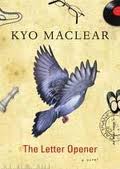
THE LETTER OPENER by Kyo Maclear (2007)


Naiko, the narrator, works in the Undeliverable Mail Office for Canada Post where she tries to reunite people with their lost possessions and orphaned letters, a task that offers a glimpse into the lives of complete strangers. There she meets the enigmatic Andrei, a Romanian refugee with a haunting past. When he disappears from work, Naiko becomes obsessed with finding out what happened to him.

I especially enjoyed the epigraphs at the beginning of each section as well as Naiko's lists of characters's personal possessions which all gesture to the elusive nature of truth. Quotations such as "We do not remember days, we remember moments" and "Dead letters! Does it not sound like dead men?" add another layer of meaning.

Try to distill your life or the life of someone you love into a handful of objects. Maclear's humanity "is an indispensable part of everything she writes. It is the basis of her commitment to history's forgotten people and its undelivered stories. Her voice is exquisite and incisive." Listen to Joy Kogawa.

STILL LIFE by Louise Penny (2004)


This is Penny's first Inspector Gamache novel set in the idyllic village of Three Pines in the Eastern Townships of Quebec. The characters are affable and endearing and even at times believably irritating. When a beloved local is killed accidentally by a hunting arrow, the townsfolk are eager to help the Surete and Chief Inspector Armand Gamache solve the crime. Penny's strength is her character development and her ability to lead you on the trails of a variety of plausible suspects until through a process of elimination you think you know whodunnit.

THE NAMING OF THE DEAD by Ian Rankin (2006)

Set in the days surrounding the G8 summit in Edinburgh in July 2005, this next to last Rebus mystery finds the inspector temporarily discharged alongside his partner DS Siobhan Clarke as they meddle in a case about the apparent suicide of an MP at the Castle. The murder Clarke and Rebus are distracted by, however, involves a recently released rapist as a victim. Many dismiss the murder as retributive justice until Rebus and Clarke uncover evidence that leads them to believe that a serial killer is on the loose.

Because of the extra political excitement of the summit, life on the the streets of Edinburgh is raised to a fever pitch with protestors pitching in to up the ante. When Siobhan has a personal reason for getting even with a riot cop, it seems all will spin out of control and right into the hands of Gerald Cafferty, the don of organized crime.

Rankin's narrative is fast-paced and Rebus and Clarke both witty and convincing. The scene with President Bush apparently happened. Read to find out what.

IN THE PLACE OF LAST THINGS by Michael Helm

Russ Littlebury leaves his settling, professional life and girlfriend in Toronto to care for his dying father back home in small town Saskatechewan. Initially torn between love and duty, Russ quickly learns to compartmentalize his life. When his father dies, Russ finds himself on an atypical roadtrip with "Skidder", his father's surrogate son, and his Aunt Jean to get Jean down to her winter home in a trailer park in Tucson. Along the way they meet some of his father's born again friends and Russ finds himself behaving true to form.

Russ's devotion to his father and self awareness make this gritty journey worth your while.